
Joel Greenblatt titled his 1997 classic You Can Be a Stock Market Genius and built the argument on spotting complexity nobody else wants to touch — spinoffs, restructurings, orphan securities where the professionals aren’t looking. The best one-line version of the book, a line Greenblatt uses to unravel ‘complexity,’ reads like so:
“As my father always says, figures don’t lie, but liars can figure.”
Given the above line from Joel Greenblatt’s excellent book, Jio Platforms is an easy public issue to analyse. Long story short, it’s not worth applying and risking being stuck with an allotment. You never know — if the issue breaks price like Paytm did, then one is really stuck in all senses of the word. That is the end of this post; and if one is really enamoured by the ‘halo effect’ of the late Dhirubhai Ambani, only then should one continue to read. The practitioner’s verdict on this issue is a single sentence. At par it’s a deal, else not at all. Everything downstream is elaboration. And the reason the elaboration matters is that the DRHP will not be evaluated by most retail applicants on its own terms. It will be evaluated by a mental shortcut inherited from another era — one that has almost nothing to do with what is actually being sold.
#1. Demand & Supply — Engineered Scarcity Meets Engineered Demand
Let’s start with how price discovery ‘happens’ — the demand and supply mechanics. Run the numbers as I have in §5 below, and you will realise that Demand is structurally manipulated. Supply is engineered scarce. That’s asymmetric, isn’t it?
But wait — that is only at the time of listing. Then the supply cliffs open.
- Month 6: The 2020 strategics — Meta, Google, PIF, KKR, Vista, Silver Lake, Mubadala, GA, ADIA, TPG — collectively 33.57% of pre-issue capital — come off their 6-month lock-in. Any of them can start selling into that same captive demand base. RIL’s excess promoter holding (above the 20% minimum contribution) also unlocks here.
- Month 18: RIL’s 20% minimum promoter contribution unlocks. The entire share register is now free.
The retail applicant is the transitional counterparty between month 0 and month 18 — buying from RIL at scarcity price, holding while the strategics distribute at demand-supported price. This is the OFS-in-slow-motion pattern the Hexaware case illustrated in When The Ducks Are Quacking…Feed Them! — spread across two years instead of one day, and driven from a fresh-issue route rather than a nominal OFS.
#2. The Cognitive Trap — Dhirubhai then, Mukesh now
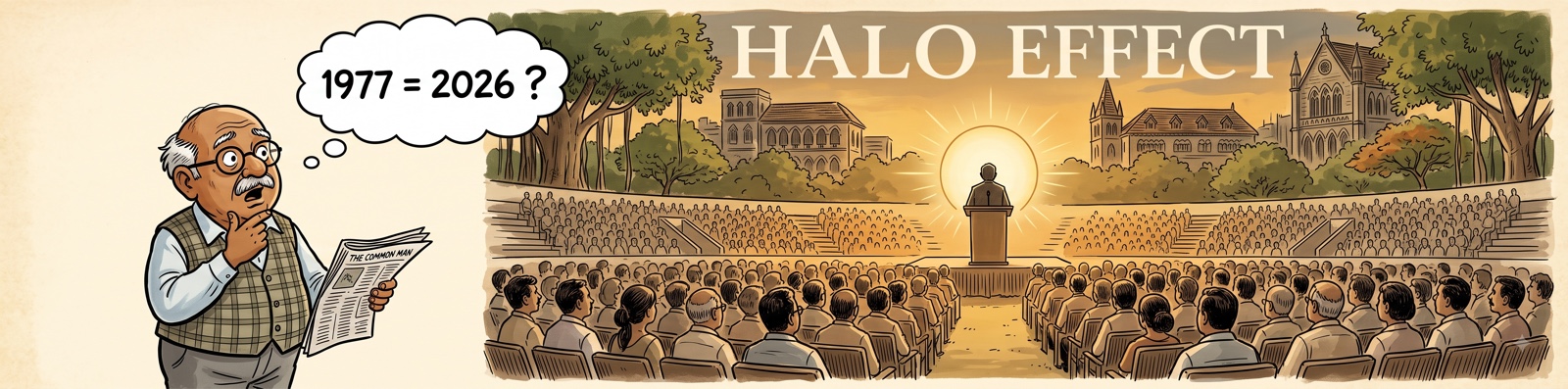
Why does retail apply anyway, despite the math above? Behavioural psychology has two names for what’s happening. The first is the Halo Effect — one salient positive attribute of a person or company generalises into a global positive judgment. The second is the Einstellung effect — a predisposition to solve a new problem the way an old, familiar problem was solved, even when the old solution no longer fits.
Dhirubhai built the Halo across forty years: mass-retail wealth creation, Cooperage Ground pilgrimages (mesmerizing persona), the promoter genuinely sharing risk with the shareholders who financed him. That halo is the raw material. The Einstellung is the cognitive mechanism through which the halo gets applied to Mukesh’s issue: “Ambani IPO = Dhirubhai IPO = wealth creation.” The halo produces the credibility; the Einstellung produces the pattern-match that skips analysis; Mukesh’s team encashes both.
The 1977 Reliance IPO priced under the SCRR float rules of the day — a 25% mandatory public float, roughly ten times what Jio is being permitted to list with. Dhirubhai did not just build a business; he built the mental shortcut every retail applicant now reaches for the moment they hear “Ambani IPO.”
The 2026 Jio Platforms IPO uses the same label. The mechanics are opposite — as §1 laid out. The promoter is retaining 66.43%. The float is calibrated to 2.9%, just over forty basis points above a regulatory floor engineered ninety-eight days before the DRHP was filed. ₹27,500 crore of the fresh capital goes straight back out to prepay ECB borrowings — a slice of a ₹71,529 crore total debt stack, not the whole thing. The marketing is through nineteen investment bankers to sovereign wealth funds ahead of retail.
The valuation requires ten years of unsold supply to remain locked. Every mechanic is inverted from the 1977 template.
#3. Lessons in Capital Allocation
I have written about how important capital allocation is for any business — you can read that here: Buffett’s One Test for Management. Most CEOs Fail It. There is an unspoken truth about the creation of ‘shareholder value’ which isn’t understood by most listed entities. The mantra is something like this:
We intend to provide value to our shareholders not just because we want to, but because we have to. In other words, providing value to shareholders is mandatory. Dhirubhai absolutely understood it — and delivered it; he didn’t need any ‘forcing function’. He seemed to do it just ‘off the bat’, as though it were a second nature of his personality, and it was evident every time he was on the dais — most importantly, he walked the talk.
Now look at Jio. Retail is being asked to fund the FX-liability swap that improves the group’s balance-sheet optics, at a multiple that assumes ten years of stasis!
#Follow what they do, not what they say
The principle that unifies everything downstream in this post is one Buffett has offered repeatedly, and Munger before him:
Follow what they do, not what they say. Words are cheap and rhetoric is designed to persuade. Capital allocation is expensive and reveals actual conviction. Every time management’s action diverges from management’s rhetoric, weight the action and dump the accompanying narrative.
Now apply the test to the Jio issue. Every headline claim in this offering has a companion action that contradicts it:
- Ambani says: “a deeply emotional moment for me, for the entire Reliance family and for millions of its shareholders.” He does: retains 66.43%, extracts only the minimum 2.9% float the regulator will let him get away with, and prices it at platform multiples.
- The prospectus says: growth-capital raise. It does: routes ₹27,500 crore straight back out to prepay foreign creditors’ loans — 38.45% of a debt stack the IPO does not even fully retire.
- The 2020 strategics (Google, Meta et al., who call themselves long-term believers) say: long-term believers. They do: hold their existing stakes at the constrained price and do not add at the current valuation. If they believed Jio at ₹12.5 lakh crore, they would top up. None have, and public shareholders don’t really know when their lock-in expires — when CAN they sell?
- The RIL group says: an integrated Jio digital ecosystem. It does: keeps Jio Financial Services (PPI, NBFC, lending, insurance) and JioStar (IPL streaming, marquee content via the RIL–Disney JV) in separately owned entities that this IPO does not include. The umbrella brand implies more than the DRHP is selling.
- SEBI says: investor-protection mandate under Section 11(1) of the SEBI Act. It does: gazettes a Minimum Public Offer carve-out for issuers above ₹5 lakh crore ninety-eight days before the largest such issuer files.
- The valuation says: Platform multiples — ~41x FY26 PAT of ₹30,053 crore, or ~50x at the high end of the ~₹15 lakh crore analyst range. It does: rest predominantly on telecom revenue, an ARPU that trails the direct listed comparator by ₹43, and a risk register that admits telecom-consumption risks.
Every one of these say-do gaps points in the same direction. The rhetoric is coordination signal. The actions are the truth. Follow what they do.
The simpler explanation is one sentence: this is a promoter monetising 2.9% of his business at the maximum price he can secure while retaining 97.1%, using the state’s rulemaking apparatus to build his ladder. Every one of the six say-do gaps above fits this hypothesis. No epicycles required. The practitioner’s verdict — “at par it’s a deal, else not at all” — is the price consistent with this simpler explanation. Anything above par requires you to believe a more complicated story in which none of the six say-do gaps mean what they appear to.
#4. The Steelman¹ Argument — what the bulls are actually right about
Play devil’s advocate for a moment.
Jio Platforms has a genuine regulatory moat. Indian telecom’s regulatory framework — spectrum auctions, AGR obligations, TRAI interconnect mediation, DoT compliance, data localization, Aadhaar-linked SIM verification — is exactly the point made in one of the chapters of the book The Compounders: From Small Acquisitions to Giant Shareholder Returns, which is that “regulated markets repel the unprepared and the unproven.” Master it and you have a decade-plus defensive perimeter. RJIL — Jio Platforms’ material subsidiary — has one. Airtel has one. Vi survives inside one. New entrants can’t construct one quickly. That moat is real — but poorly monetized and structurally exposed. Jio’s monthly ARPU of ₹214 sits ₹43 behind Bharti Airtel’s ₹257 on the same regulatory framework; matching Airtel’s ARPU would add ~₹27,000 crore in annual revenue.
And Jio itself flags as a business risk “any regulatory developments that restrict or limit the use of social media, including by minors or involving the online gaming industry” — a telecom-consumption risk, not a platform risk. Jio Platforms’ revenue is overwhelmingly telecom — the DRHP’s own disclosure. The label prices Platform; the mechanics deliver telecom.
#The Moat-Becomes-Cage Inversion for Jio
Every moat has a story worth telling, and here is a structural pattern worth naming: the ‘Moat-becomes-Cage’ inversion.
Take the Bombay Stock Exchange. Its pre-1994 geographical monopoly was its moat — the regulatory framework that kept regional exchanges from expanding into Bombay was BSE’s protection. When NSE deployed VSAT satellite trading in 1994, that same geographical restriction flipped into BSE’s cage: floor-tied to Dalal Street, BSE could no longer expand out to compete for national volumes. What had been the entry barrier for competitors became the exit barrier for the beneficiary. The BSE governing board was the last to notice.
This is Christensen’s Innovator’s Dilemma in action: a moat against today’s competitors is not a moat against a disruptor who starts above the stack. The incumbent’s own values — protect existing ARPU, existing spectrum investment, existing tower CAPEX — actively forbid it from responding decisively.
Every entry barrier for competitors is potentially also an exit barrier for the beneficiary once the environment shifts.
Jio sits in exactly that position. Its shield in 2026 is its cage in 2036. And there is a very real, current instance of this happening. The instance has a name and it’s called SpaceX aka Elon Musk².
#5. The Thumbs Down That Cannot Happen
Writing about regulation in India is farting against thunder. SEBI won’t read this. The Finance Ministry won’t read this. Even if they did, they’d file it and move on. But there is one entity that has no choice but to notice — the primary market itself, at the moment it opens for subscription. If enough of us give a thumbs down at that specific moment, the numbers cannot be hidden. Undersubscription is the market’s own regulator — the one that regulates SEBI.
To be honest, even such signalling cannot happen. The reason being that the biggest inflow into structurally manipulated issues does not come from the retail applicant with a ₹2 lakh cheque. It comes from mutual funds — because SEBI itself mandates that at least one-third of the anchor book be reserved for domestic mutual funds. Not a suggestion. A hard floor. For a Jio-scale issue the anchor book alone could be ₹11,000–12,000 crore, of which ₹3,500–4,000 crore will flow through the mandatory MF one-third floor before retail sees a single share priced.
Whose money is that? Every SIP flowing in from every ordinary Indian who thinks their monthly ₹5,000 is being deployed by a professional. The professional has been given no choice. He must show up. He must bid. He must own it — not because forty-five fund managers independently concluded that a 41x P/E, 2.9% float, 66.43% promoter-locked issue is a compelling investment, but because SEBI’s own one-third anchor floor forces them to be there.
Now the deeper mechanism — it runs AFTER listing. The anchor floor is a one-time trigger. But SEBI’s mutual-fund categorisation rules require large-cap MFs to invest at least 80% of their assets in the top 100 companies by market capitalisation. Once Jio lists at ~₹12.5 lakh crore, it automatically enters that top 100 by a wide margin. Every large-cap MF in India is then structurally required to hold Jio in some weight, in perpetuity, irrespective of the fundamentals. Add the passive layer — Nifty 100 / Sensex-adjacent index funds and ETFs mathematically buy in proportion to index weight — and the forced-buying wall is not a one-time issue-day mechanic but permanent structural demand.
This is what Warren Buffett called the Institutional Imperative — institutional capital’s tendency to imitate the crowd rather than exercise independent judgment. The active fund manager who knows Jio is overpriced and underweights it faces tracking-error risk against the benchmark that mechanically owns it. Career risk overrides analytical judgment. Everyone bids for the same reason: not because they believe, but because they cannot afford not to.
Before I name what’s happening here, a metaphor. There is a famous adage, often attributed to Mark Twain: “A banker is a fellow who lends you his umbrella when the sun is shining, but wants it back the minute it begins to rain.” The banker has all the leverage — the borrower has no alternative when the rain starts. That is what negotiators call BATNA³ — Best Alternative To a Negotiated Agreement. Strong BATNA, you can walk. Zero BATNA, you take whatever terms are offered. SEBI, one carve-out at a time, has engineered the Indian mutual-fund industry into a position of zero BATNA at the exact moment Jio comes to market.
The net effect: the buyer’s BATNA — walk away, hold cash — has been structurally destroyed at five layers: SEBI’s one-third mandate on issue day, the 80% large-cap rule after listing, passive index tracking, the over ₹30,000 crore/month SIP wall that must be deployed, and career-risk/tracking-error on the individual PM. The system has been engineered such that the buyer has nowhere to walk to. The seller knows it. That is why it is being offered to us at a stupidly exorbitant multiple — that smacks of audacity, sheer chutzpah.
#Conclusion
The late Dhirubhai Ambani was a ‘Stock Market Genius’, absolutely. The Ambani group avatar that manifests today isn’t anywhere close.
The Jio DRHP is propped up by the apparatus around it — the Institutional Imperative, the BATNA, the entire forced-buying structure that guarantees the ducks will quack in unison.
And what the Ambanis are selling is a ‘platform’ — a business model that AI is structurally close to declaring as dead.
Vote with your feet — give it a pass.
#Notes
¹ On steelmanning. Steelman (sometimes steel-man or steel man) refers to a strong or effective opposition (an argument or adversary) set up in order to test or challenge one’s own rhetorical position. Steelman is the opposite of straw man, which refers to a weak or imaginary opposition set up only to be easily refuted. A steelman argument is the strongest possible version of the case one can imagine one’s opponent making. See: Merriam-Webster on steelman.
² How the Musk / Starlink threat is unfolding. Elon Musk’s Starlink has become Nigeria’s #2 ISP within two years of launch (~92,000 subscribers, forcing incumbent Spectranet to lose share) and is now active across 19 African markets. Starlink received India’s GMPCS license in June 2025, and India has settled on administrative rather than auction-based allocation for satellite spectrum — the exact policy Jio and Airtel lobbied against. Jio has hedged by launching Jio SpaceFiber with Luxembourg’s SES (a JV called Jio Space Technology Limited, JPL 51% / SES 49%), but that is a reaction to the threat, not a defence against it. Airtel Africa (across its 14 markets, Nigeria included) has partnered with Starlink for Direct-to-Cell satellite-to-mobile connectivity, turning a threat into a channel; whether Jio takes the same approach or fights it will depend on which side the RIL group’s satellite economics ultimately land. Either way, the “regulated markets repel the unprepared” logic assumes the regulated market itself doesn’t get reclassified by a technology shift that regulators then bless. In telecom, that reclassification is now underway.
³ On BATNA (Best Alternative to a Negotiated Agreement). BATNA is a negotiation-theory concept introduced by Roger Fisher and William Ury in Getting to Yes (1981). Your BATNA is the best outcome you can achieve if the current negotiation fails — your walkaway option. The stronger your BATNA, the greater your leverage in the negotiation; the weaker your BATNA, the more you must accept whatever the counterparty offers. In markets, the buyer’s BATNA is typically “hold cash and wait for a better price.” When that walkaway option is structurally destroyed — through regulatory mandates, career-risk incentives, or forced-deployment obligations — the buyer has no leverage, and the seller can dictate terms.
