#1. Business Model
NSE is a network-effects business, and instead of my explaining the term, interested readers should read What is a Network Effect. In terms of business attributes, NSE has held a near-monopoly in the F&O (Futures & Options) segment — dominant, though not uncontested, as the Risks subsection below covers.
Trading on NSE was officially launched on the Diwali Muhurat day (the truncated session during Diwali) in 1994, and was restricted to a small group of only 30 scrips. Most readers do not have the whole picture since it is almost 32 years since trading commenced on NSE. Before the advent of NSE we had only one stock exchange — the Bombay Stock Exchange (BSE). One of the restrictions built into BSE’s operating model in those days was that its floor-based, open-outcry trading system was physically tied to Dalal Street in Mumbai; brokers had to be present on the floor, and BSE could not extend its trading network beyond the geographical limits of Mumbai. NSE, on the other hand, was formed with no such restriction. BSE was not screen-based; NSE came in with VSAT technology and revolutionised the way trades were executed. Very soon, NSE was nationwide. BSE had to wait it out — BSE launched its own electronic trading system (BOLT) in March 1995, and was progressively allowed to extend BOLT terminals outside Mumbai from around 1997 onwards, but by that time NSE was already entrenched as the dominant nationwide exchange.
The disruption in the stock-exchange business model was what NSE brought about.
For an extended period post launch, executing trades on NSE was not comparable in any shape or form to trade execution on BSE. Remember — F&O as a market segment did not exist in those days. In other words, NSE gave investors a CHOICE. Investors embraced the choice wholeheartedly. The late R.H. Patil was single-handedly responsible for this achievement during his stint at NSE.
As of today, investors can place cash-market trades on either NSE or BSE — it is a duopoly. In the F&O segment, NSE has been the dominant exchange — historically a near-monopoly, though as the Risks section below covers, BSE has taken meaningful derivatives share since 2023. Even so, NSE remains the dominant F&O exchange by a wide margin. Like all such businesses, NSE is an excellent business, no arguments at all.
NSE’s DRHP lays out the roadmap for listing. NSE will be listed on and traded on BSE — NSE cannot list on its own platform; the meta-circularity is also a literal infrastructure constraint. Similarly, shares of BSE are listed but they do not trade on the Bombay Stock Exchange — they trade on NSE; vice-versa for NSE.
One more thing before moving to the OFS mechanics. NSE has two other revenue streams beyond transaction charges that deserve mention, because they are the reason a genuinely long-term holder might own the stock at almost any price — provided the horizon is forever. NSE Indices Limited (NIL) — formerly IISL, the S&P joint venture NSE has since bought out — owns and licenses the Nifty family. Every ETF, index fund, and derivatives contract referencing a Nifty index pays a licensing fee. This is passive-investing coupon — it compounds with AUM in Nifty products and grows independent of daily trading volume. NSE Data Services — the market-feed business — sells real-time and historical data to institutional subscribers, terminal providers, and algo/HFT shops. Together the data and index franchise is perhaps 8-12% of NSE’s top line today, but it is the highest-quality revenue NSE has: recurring, high-margin, and structurally decoupled from trade volume. Over a horizon measured in decades — the only horizon that lets you ignore entry price — the data franchise is the compounding machine buried inside the exchange.
Here, the Klarman line matters:
“Market participants do not wear badges that identify them as investors or speculators. It is sometimes difficult to tell the two apart without studying their behavior at length. Examining what they own is not a giveaway, for any security can be owned by investors, speculators, or both.” — Seth Klarman, Margin of Safety.
What separates the holder for whom price does not matter from the holder for whom it does is not the security they own; it is the horizon they hold it over. If your horizon truly is forever, the Nifty franchise is the reason to own NSE at any price. If it is not, we are having a different conversation — and the rest of this post is that conversation.
#Risks
Any responsible business analysis has to name what could go wrong. NSE has real risks, and the biggest one is not the one that retail commentary tends to focus on. In descending order of materiality:
1. Option-volume regulatory risk — the largest single exposure. Roughly 70% of NSE’s revenue is F&O, and within that, index options — specifically weekly Nifty and Bank Nifty options — do the heavy lifting. These are the products retail has been trading at scale since 2020. SEBI’s September 2024 study on individual traders in the equity F&O segment found that a large majority of retail participants lose money. The regulatory response is already in motion: expanded lot sizes, one-weekly-expiry-per-exchange, tighter margin norms, and continued signalling from the current SEBI chair Tuhin Kanta Pandey that retail speculation is not something the regulator will sit still on. Every incremental rule tightens the option-volume base that today underwrites NSE’s earnings. A meaningful compression is not a tail risk — it is a working assumption for any honest analysis.
2. Competitive risk from BSE — demonstrated, not theoretical. The 2023-2025 period showed how quickly the derivatives market can shift when regulatory posture changes. Under the previous SEBI chair (Madhabi Puri Buch), a series of rule changes — the one-weekly-expiry-per-exchange mandate, brokers being required to register clients on both exchanges by default, and differential treatment on lot sizes — moved BSE’s derivatives market share from single digits to roughly 22% by early 2025, largely on the back of Sensex weekly expiry becoming a real alternative to Bank Nifty. NSE’s counter-move in February 2025 — shifting Nifty expiry to Monday, ahead of BSE’s Tuesday — is a defensive play, not a durable moat. The point is not about which exchange wins any given quarter. The point is that regulatory posture changes, and when it does, a duopoly’s economics can shift by tens of percentage points in a matter of months.
3. Governance and legacy overhang. The ₹1,300 crore co-location settlement of January 2026 is closed with SEBI, but civil litigation from broker-plaintiffs continues, and the reputational overhang from the Chitra Ramkrishna / Anand Subramanian era has not fully cleared. Any adverse ruling or fresh SEBI enforcement action against NSE would compress the multiple immediately.
4. Nifty-franchise substitution risk. The compounding index-licensing revenue identified in the paragraph above is not indestructible. MSCI and S&P already run competing India indices for global institutional investors. Domestic passive flow is captive to Nifty for now, but a shift by even one large domestic asset manager to a non-NSE benchmark would trim NIL’s revenue stream at the margin.
5. Technology and infrastructure risk. The 2015-2017 co-location episode was an infrastructure-level failure with regulatory consequences NSE is still paying for. Any recurrence of preferential access, tick-latency arbitrage, or system failure would invite immediate SEBI action.
The concentrated risk is (1) — the option-volume regulatory arc. The most under-appreciated risk is (2) — the demonstrated speed at which regulatory posture can shift a duopoly’s economics. Neither is priced into a 48x multiple.
#2. OFS versus Fresh Issue — what the words actually mean
Equity is ownership capital. Permanent — no repayment, no maturity, no contractual return. The IPO is the top of the funnel — the primary mechanism by which equity ownership in a company gets created. In that sense the IPO is a necessity in the world of equity investing, for everything downstream “to work.”
A fresh issue creates new shares. The company prints equity it did not previously have, the cash hits the operating account, and the balance sheet acquires new permanent capital. It is forward-looking. The price the buyer pays funds the things the prospectus promises.
An OFS — Offer for Sale — does none of that. Existing shareholders sell existing shares. No new equity is created. The cash goes to the seller’s bank account. The operating company receives ₹0. It is backward-looking. The price the buyer pays funds the seller’s exit. NSE is an Offer For Sale of existing shares by incumbent shareholders.
The OFS seller prices their sale to willingness-to-pay — the only way the potential buyer makes money in any OFS is if the strike was set below the post-listing equilibrium. The structure of any OFS is designed to prevent that from happening. Contrast that with a business that is not sold as an OFS. The fresh-issue company is not optimising exit; it is raising capital it wants to put to work, with promoters still inside the company on Day One. The two sellers are not playing the same game.
NSE will be the largest mainboard OFS in Indian history — roughly 3.5x Hexaware. ~₹30,000 crore to ten financial institutions. The operating company — NSE — receives nothing.
Aswath Damodaran, the valuation guru, has a line worth carrying through this whole post: don’t mistake pricing for valuation. Pricing is what the next buyer will pay; valuation is what the asset is worth. Any OFS structurally does exactly what Damodaran warns against — it sets the strike at the upper edge of willingness-to-pay, and asks the retail subscriber to read that strike as if it were the company’s value. I think this is lost on most investors. Does it matter? The short answer is that it absolutely does. For those of you who think of any new listing solely from the point of view of the listing pop, then you are probably reading the wrong blog. There is nothing wrong about the listing-pop mechanism — but don’t call yourself an investor.
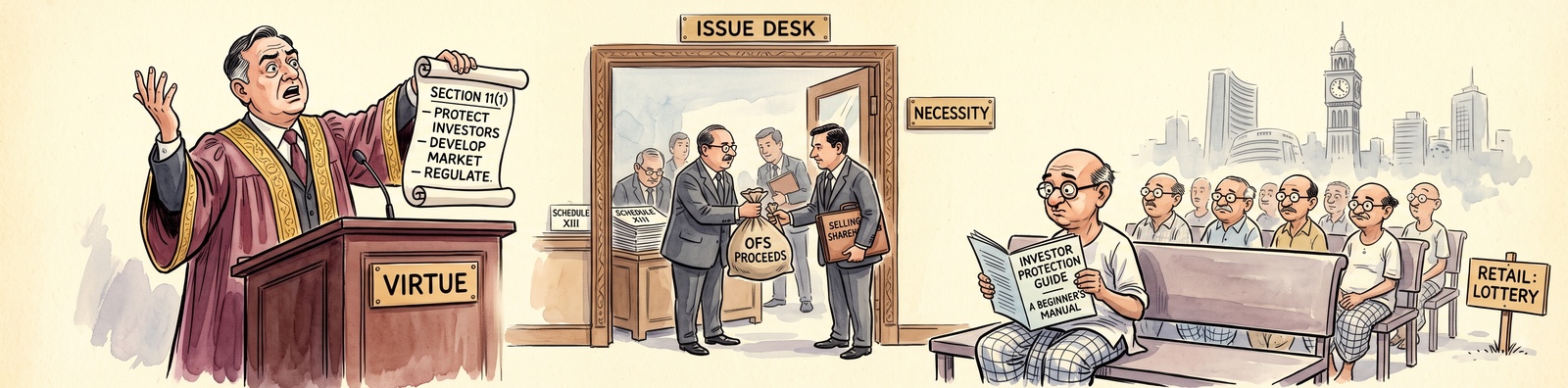
The eagerness to participate in the NSE OFS is, in one word, EPIC — and rightly so. NSE is as close to a sure thing as investors can aspire for. Hence all of us want to invest in it. Truth be told, NSE did make a virtue out of a necessity — it absolutely did, no doubt about it. Pre-NSE, things were so different that most readers will find them unbelievable.
Necessity and virtue are different categories. A road, a port, a stock exchange — necessary, none of them virtuous. The market structure surrounding any of them can be well-designed or badly designed, fairly priced or extractive; the underlying transaction-clearing work is the same in either case. The market structure is what is open to moral evaluation. The mechanism is not. The most honourable explanation is: NSE is a natural evolution of how things tend to happen.
#3. Investing in the NSE OFS — the Mode Error
All of us are susceptible to what is called a mode error.
Mode Error: When a device has different states (modes) where the same controls have different meanings, and the user believes the system is in one mode when it is actually in another.
NSE (2026) is not the same animal as NSE (1994). What the late R.H. Patil ushered in was certainly a virtuous business. How virtuous is NSE (2026) compared with NSE (1994)? The short answer is: it is not. For those of you who are investing in the true sense, and who are thinking that NSE is very virtuous, I urge you to think again.
#4. How to think about NSE (2026) — Valuation Metrics
Any of us investing in any business defaults to thinking about — how much can I make when I actually put money to work in this game? If I were to invert the question and ask instead, how much can I lose?, it leads us to the more useful follow-up questions.
Valuation does matter, but it is just one of many things that do matter. Is NSE correctly valued at its OFS price? I’d rather leave the valuation argument to the pundits — not my bailiwick. What matters to us is our cost basis, and the entry point at which we invest.
Buffett’s 1986 tulip-bulb test is worth mentioning:
“If you could buy a company that owned twelve tulip bulbs for a 20% discount to the value of those tulip bulbs, would that be a bargain?”
In plain English, a discount from an irrationally high price is not value. The entry point matters more than most of us realise. And once we invest, we have zero control over what happens next. We do have an illusion of control when we stare at the price and watch it dance all over the place — but it is an illusion. Chuck Akre says it best:
Your starting price is the most important one and it is actually the ONLY thing that you can control. — Chuck Akre
The idea is to buy a business that is a compounding machine; the underlying business compounds at an above-average rate and the valuation re-rates higher. NSE has all the attributes of being such a business.
Investors tend to confuse VOLATILITY with RISK. Volatility isn’t the same as risk. The probability of permanent loss of capital — which is the defining feature of risk — is very low when one is investing in NSE. Businesses like NSE are rare. But let me reiterate: ‘the starting price has everything to do with your compound return.’ What the OFS price will do is anchor all of us, forever. How will it affect our compounded return? Only time will tell. But do remember — the entry price is part of the bet; a wonderful business at a rich price is a bad wager. NSE has already won the race with BSE; the question is, will it continue to win? The fact that it has won the race thus far is already reflected in the OFS price, isn’t it?
In monopoly-by-economics moats, profitability is decoupled from quality. Business quality and stock return are different things — price determines return, not quality. Never confuse “great company” with “great investment.” Underwrite the price, not just the franchise. Bottom line: an amazing business does not make for a good investment. Buffett says it best:
Buffett on newspaper monopolies: “there is no correlation between profits and excellence. You essentially have a business that will make a lot of money if you’re terrific [and] it will make a lot of money if you’re lousy. There’s no difference. You pick a paper that you tell me you think is lousy and I will show you one with 30% profit margins.”
Howard Marks draws the sharpest bright line in the value-investor tradition — which assets can you NOT value analytically? Marks’s answer: “assets that throw off no cash flow — diamonds, furs, paintings, a barrel of oil, gold, and Bitcoin. If something doesn’t throw off cash flow, you can’t say what the fair value is.” The mechanism is arithmetic — intrinsic value is the discounted lifetime cash stream; with no stream there is no computable fair value, so any purchase is driven by price expectation and FOMO, not analysis. “You can’t justify it analytically.”
NSE is a cash-flow business — F&O fees, listing fees, data revenue — and sits squarely on the analysable side of Marks’s line. But even a cash-flow asset gets pushed to the speculative side when the market price runs so far ahead of the discounted-cash-flow math that no reasonable growth assumption bridges the gap. At ~48x trailing earnings on a declining base, the buyer is no longer paying for cash flow — the buyer is paying for the price expectation. Marks’s bright line runs through NSE not because it lacks cash flow, but because the OFS band puts the pricing on the wrong side of it.
#5. Follow the Money
Before the Follow the Money questions, a note on method. Any company analysis worth doing has to pass a general-semantics sanity check — Alfred Korzybski’s frame for keeping thought accountable to what actually exists. Five steps:
- What does this specific company actually do? (extensional — describe the object, not the category)
- How has it changed since the last time I looked? (dating — the analysis I ran in 1994 is not the analysis that applies in 2026)
- How does it differ from peers? (indexing — NSE₁ ≠ NSE₂; NSE ≠ BSE ≠ MCX ≠ CME)
- What am I inferring versus what am I observing? (the single most dangerous step — inferences carried forward without being re-observed become dogma)
- What environmental factors affect this business right now? (chain indexing — the macro, regulatory, and competitive context is not the same context as ten years ago)
The mode-error argument in §3 above is Korzybski’s step 4 gone wrong: an inference (“NSE = virtuous disruptor”) drawn in 1994 and carried into 2026 without being re-observed. Most of what passes for company analysis in Indian public markets is dated inference — the argument that NSE is a wonderful business is not wrong today, but the analysis saying so is often the one somebody ran a decade ago and never updated. That is why the questions that follow are worth asking now.
These are the questions I am asking:
- Who is selling and what will they do with the moolah? We don’t know where the money is going, do we?
- What does NSE do with the cash the business (not the OFS) generates? Fact is that NSE is going to gush cash any which way. What is it going to do with the cash? The prospectus is silent on that. Will it return it to us in the form of dividends?
- What does NSE do for its customers — the common investor? It pretends to be virtuous — is it? We shouldn’t be looking only at historical figures; we have to look ahead. How much can NSE as a business GROW from here? NSE was virtuous — is it as on date?
Let me try and make an educated guess at the answers:
- The structure of any OFS is such that NSE as a business gets exactly zero from the OFS proceeds.
- What are the two general sources of return from any business?
- Existing cash flows — what the business generates today.
- Potential future cash flows — growth. NSE’s growth from the OFS price is not a given either. It is so heavily regulated and constrained, I would not hazard a guess. These businesses are heavily dependent on market sentiment, global flow of funds, politics and macro-economics. Not my shtick since there is too much forecasting involved. People commonly conflate a business’s actual return with its growth. If you don’t think there is much growth, the existing cash flows have to support the valuation — which just means you pay a lower price. Growth and return are two separate things; we shouldn’t conflate them. A good company could be a bad stock and vice versa.
- Is NSE a PSU? No. NSE is a private limited company incorporated on 27 November 1992. Its founding shareholders were public-sector-adjacent financial institutions — IDBI, ICICI, LIC, GIC, IFCI and others — but the exchange itself is not classified as a Public Sector Undertaking. The government does not hold a direct equity stake in NSE, and NSE is not subject to the CPSE governance framework applicable to PSUs. Post-OFS, the largest single shareholder will remain LIC (~10.72%), but the shareholding is widely dispersed across public-sector institutions, foreign investors, and private financial holders.
The reality is that NSE is today a bureaucratic mess — which surfaces the Munger line:
Munger (USC Law, 2007): “Complex bureaucratic procedure does not represent the highest form civilization can reach.” He also says: “A seamless, non-bureaucratic web of deserved trust.” His test: “If your proposed marriage contract has 47 pages, my suggestion is that you not enter.”
Does NSE qualify? I think not — not even close. As of today, NSE and BSE are just extended arms of SEBI; they might as well merge all of them. What SEBI, and by extension NSE and BSE, aspire to do is to control market direction and price discovery. It is lost on them that neither of these two things is part of their mandate.
#6. A decade of OFS — let the buyer be aware
Twenty-five mainboard IPOs from late 2010 to early 2025. Fourteen OFS-heavy, ten fresh-heavy. The tables below are the dataset. The analysis is short. We present the receipt; you decide.
Table 1 — OFS-heavy IPOs, 2010–2025 (14 issuers)
Three observations.
The listing-day pop gap is the cleanest single signal in the dataset. Median OFS pop, +8%. Median fresh pop, +66%. Eight times wider on fresh. OFS sellers price for willingness-to-pay; fresh-issue companies leave money on the table because their interests don’t terminate at the listing — the promoter is still inside the company on Day One; the OFS seller, often, is not. The gap is the gap between two incentive structures, sitting in plain numbers.
The single-IPO rule “OFS underperforms” fails honestly. HDFC AMC compounded +138%. Mankind Pharma +124%. Vijaya Diagnostic +139%. Coal India +86% on price alone — materially more on dividend total return. All four were pure OFS. Franchise quality matters. The market structure does not help the retail allocator distinguish HDFC AMC from Paytm at the IPO desk — same Schedule XIII machinery, same financial sellers, same willingness-to-pay pricing. One compounded. One is half its issue price. The structure was the same. The franchise was not.
Mega-OFS at peak demand: five out of five underwater or flat. LIC −53%. Paytm −49%. Hyundai India flat. Star Health −37%. Bajaj Housing +22% vs issue, roughly halved from listing close. The 2021–2024 peak-demand mega-OFS cohort is unanimous. NSE at ~₹30,000 crore would be the largest entry in it.
#7. Three things the data does not say
I am not building a single-variable predictor here. The OFS-versus-fresh split is the cleanest signal of how the market structure is pricing the transaction. It is not a complete predictor of how the investment ends.
It does not say “OFS predicts failure.” HDFC AMC and Mankind compounded for the patient buyer. Coal India’s total return including fifteen years of dividends is materially higher than the price column above suggests. Vijaya Diagnostic delivered. The market structure does not stop a good business from being a good business — it just doesn’t help the retail allocator find it among the queue.
It does not say “fresh-issue protects you.” Ola Electric −44%. MobiKwik −29% from issue, more than halved from listing close. NTPC Green −10%. Burger King India — Restaurant Brands Asia — ~49% below listing close. Fresh capital, into the operating company, did not fix the unit economics in any of them. The fresh-issue structure is not the business-quality solution.
It does not say “the market structure critique is a fresh-vs-OFS critique.” The Schedule XIII discretion, the 20-BRLM syndicate structure, and the regulatory accommodation immediately preceding any large filing all cut across issue types. The OFS-vs-fresh axis is the cleanest signal. It is not the only test the market structure has to pass.
The biggest confounder is vintage and sector. The 2021 cohort listed at peak post-COVID liquidity; the 2024 into a correction. The post-listing return depends on franchise quality, vintage, and the price the band was set at — none of which retail has informational leverage on at the IPO desk.
#8. Global Valuations of similar businesses
#Comparable listed bourses — what the float looks like now, and what it matures into
Two Indian bourses are already listed: BSE (listed February 2017, ~9 years) and MCX (listed March 2012, ~14 years). Both started as institutionally concentrated demutualised exchanges. Both demonstrate what a decade of secondary-market evolution does to the shareholding pattern — and they have diverged sharply. The DRHP discloses NSE’s post-issue pattern (per ICDR Reg 24); the comparable listed exchanges’ patterns are public as of their most recent quarterly disclosures.
Table A — Shareholding pattern: NSE projected post-IPO vs BSE current vs MCX current
Three observations.
Both BSE and MCX list with zero promoter — and NSE will too. This is the demutualised-exchange model. The post-listing market has to set price discovery without a controlling block to anchor it.
BSE has matured into retail dominance (~64%) over nine years. From a 2017 listing-day profile that would have looked closer to NSE’s projected starting point, BSE’s float has progressively redistributed to individual investors. The path: institutional sellers trim into a willing retail bid as the post-listing multiple compresses to global-comparable levels.
MCX has gone the opposite direction. Domestic institutions hold 54%, foreign institutions another 26% — combined ~80% institutional. Retail at 15%. The 2013 NSEL crisis forced the original promoter (FTIL, now 63 Moons) below 2%; the float was rebuilt by institutional buyers, not retail. The structural lesson: there is no automatic retail-accumulation path. Whether it happens depends on the multiple at which the stock trades over the cycle and whether retail finds the franchise attractive at those prices.
NSE’s likely path is between the two. Higher F&O concentration than BSE (which is cash-heavy) and a thinner moat than MCX (which has commodities exclusivity). The realistic 10-year shape — and the question the patient retail buyer must answer at the IPO desk — is whether the stock’s institutional concentration relaxes through retail accumulation (the BSE path) or holds through institutional dominance (the MCX path). Neither path validates paying ~48x today.
#Implied valuation against the global cohort
NSE’s implied issue valuation is ~₹5 lakh crore (~$60 billion at current FX). Against FY26 PAT of ₹10,302.6 crore (down 15.5% YoY from FY25’s ₹12,188 crore; revenue ₹16,601 crore, down 3.1% from ₹17,141 crore — per DRHP press extracts), the implied trailing P/E is approximately 48x.
For context on the operating quality of the business: NSE reported an Operating EBITDA margin of ~67%, a PAT margin of ~56%, and a Return on Equity of ~33% in FY26. These are exceptional margins by any global exchange standard. The valuation question is not about the quality of the underlying business — it is about the price being paid for it.
Listed exchange operators globally trade in a band of ~16-38x trailing earnings. The comparable cohort, in USD.
Table B — Global listed exchange operators (mid-2026, USD basis)
For the first six months NSE will trade as a 4-6% float stock — among the thinnest of any Indian mainboard at its valuation. Price discovery in that window is institutionally dominated and structurally volatile. At Day 180 the entire ~233 crore non-OFS-sold pre-issue base becomes eligible to trade. Eligible is not the same as selling. The ~24.81% combined held by sophisticated long-term non-sellers identified in §9 below — LIC, SBI Capital Markets, Mahogany, Premji Invest, R.K. Damani and others — will likely stay put. The remainder, ~70% of paid-up held by 250+ smaller pre-issue holders, is the latent supply that determines what “wait for a better price” can actually mean for the retail buyer.
#How the post-listing trade looks
Cross-reference the float table and the valuation table. NSE will trade as a thinly-floated ~48x P/E exchange against a global cohort of 16-36x more-liquid comparable global exchanges. Every prior mega-OFS at peak demand in the §6 dataset — LIC, Paytm, Hyundai, Star Health, Bajaj Housing — is currently underwater or flat. Mr. Market does not historically wait long, on this kind of setup, to deliver a wait-for-a-better-price window. The patient retail buyer’s question is not whether the window comes. It is whether the price the IPO desk wants today needs to be paid today.
#9. NSE — the architect itself
100% OFS. ~₹30,000 crore. 14,89,05,525 shares — about 6% of paid-up capital, implied valuation in the neighbourhood of ₹5 lakh crore. Pure exit transaction; the operating company receives ₹0.
Ten selling shareholders — SBI the largest at 2.47 crore shares, CPPIB next at 1.187 crore (i.e. ~11.87 million; press extracts of the DRHP have been mis-stating this as 1.87 cr), with Morgan Stanley Strategic (Mauritius), Bank of Baroda and five public-sector insurance / custodian entities behind them. State-side, foreign-PE-side, insurance-side — a coordinated exit. Laid out side by side:
Table D — NSE OFS selling shareholders
One detail in the table worth pausing on. MS Strategic (Mauritius) Limited — the third-largest selling shareholder by share count — is an associate of Morgan Stanley (per the DRHP shareholding extract reproduced by Business Standard). Morgan Stanley India Company sits in the 20-BRLM syndicate as one of the book-running lead managers. The Morgan Stanley group, in other words, is on both sides of the issue — one group entity assembling the order book and parcelling out the anchor allocation under Schedule XIII discretion, another group entity taking cash off the table as a selling shareholder. Standard Chinese walls between investment-banking and proprietary holdings exist; they do not change the structural observation that the same corporate group is on both sides of the transaction. Schedule XIII’s “the lead manager picks which anchors get allocated” problem is not a hypothetical. In this issue, one of the group’s units is picking, while another of the group’s units is being paid.
The analogy that fits is one Richard H. Lawrence Jr. drew thirty years ago, in a different corner of Asian finance.
Lawrence ran Overlook Investments out of Hong Kong for thirty-seven years; he tells a story in The Model about a security-analyst luncheon at the Hilton on Queen’s Road Central in the early 1990s. At his table sat the Managing Director of Hong Kong’s largest asset manager. The conversation turned to soft-dollar brokerage fees — a practice then under investigation in the HK investment-management community. The MD spoke in defence of soft-dollar commissions. Lawrence’s reading, recorded years later:
“Soft dollar brokerage fees, in my view, are just stealing from one’s clients. I called him out on it. He shrugged as if to say, ‘Let’s agree to disagree.’ He and his firm fell in my esteem.”
The Morgan Stanley arrangement in NSE’s DRHP is not a soft-dollar transaction. But Lawrence’s structural argument — “a blatant conflict of interest that must be eliminated” — applies word-for-word: one corporate group benefits while the cost is borne by the people not at the table, and the industry’s response is the Chinese-walls equivalent of “let’s agree to disagree.”
(One more table-level note worth flagging: Aranda Investments (Mauritius) is Temasek’s vehicle; the 4.54% pre-IPO stake places Temasek as the second-largest single holder of NSE after LIC — and Temasek is choosing to trim only ~10% of that stake.)
None of the ten selling shareholders is doing a Hexaware-style 100% exit. Every one of them is partial-exit OFS — they reduce, they do not leave. The stake they retain is the bet they have not sold to the retail subscriber. It is a trim, not a liquidation — and the market structure rewards the trim because the seller keeps optionality on the residual while taking cash on the slice. The “% of own stake sold” column tells the story in one number: the diversified financial-institution holders trim between 10% and 31% of their position. No-one liquidates.
LIC — the single largest NSE shareholder at 10.72% — is not selling. The largest insider holds. The other ten cash out — partially. The people not selling believe the news is not yet priced. The people trimming believe it is. Retail is being asked to take the opposite side of the trade the ten trimmers are putting on.
The mirror observation matters. LIC at 10.72% is not the only sophisticated long-term holder choosing to retain its stake. Premji Invest, R.K. Damani, Mahogany Ltd, Crown Capital, DVI Fund, TIMF Holdings, and Oriental Insurance — each holding between 1.42% and 3.73% — also abstain from the OFS. So does SBI Capital Markets at 4.33%. These are the holders who, applying the expectation-in-the-price test, do not believe the news has yet been priced in. The selling shareholders — the diversified financial-institution holders trimming 10–30% of their stake — disagree.
What would change this pattern is what Charlie Munger named in 2012: “If we change the incentives, a lot of this regrettable behavior would go away.” The market structure rewards what it measures. Right now it measures listing-day pop, anchor-day strike, and OFS clear-out. All three are short-term. All three pay the seller, the lead manager, and the flipping anchor. None pays the retail subscriber for holding the asset the market structure was supposedly built for.
Munger had a counter-warning in the same talk worth carrying alongside: once the wrong culture gets entrenched, it builds political power that protects the regrettable activities themselves. On 13 March 2026 SEBI gazette-notified a change to the minimum-public-offer rule — the dilution floor dropped from 10% to 2.5% for issuers above ₹5 lakh crore in valuation. The market structure made the door narrower exactly where the largest issuers needed it narrower.
A note on register. This is not a hostile-to-NSE post. The single largest reason a retail investor in 2026 even has the architectural choice of an IPO on a market-cleared screen is NSE itself. The political will to create a new exchange came from SEBI and the Finance Ministry in 1992-93 — a deliberate move to break the open-outcry cartel BSE had run since 1875. The architectural design came from the late R.H. Patil — screen-based, anonymous, nationwide; India’s first instance of an architect giving the small investor a structurally fair quote-driven order book. NSE wasn’t a better version of BSE; it was a different architecture. Retail in 1996 didn’t have to compare the two — they had a genuinely better choice. The fact that you can read a critique like this one, and trade on a screen as you do it, is the Patil-era legacy.
The point of recalling that history is precise. NSE proved that architectural choice, delivered by the architect, is what shifts retail’s structural position. The self-belief of a pioneer is a powerful thing — and normally, when the experts propose untested solutions, they are not the ones who suffer the consequences. Patil’s architecture was untested in India in 1992; had it failed, the consequence would have been his. SEBI is sitting in the same chair the 1992 SEBI sat in. The question is whether it will use it.
#The bottom line for the buy-and-hold reader
All of this reduces to one question the buy-and-hold reader of this post has to answer. The entry price is the bet — the only part of the bet you actually control. NSE is a wonderful business; but a wonderful business at a rich price is a bad wager, and the decade of receipts (§6) says Mr Market will offer you the same franchise at a fairer price within twelve months of listing on the pattern above. The patient owner’s discipline — denied at the IPO desk, restored by the secondary market — is either the discipline you will apply, or the one you will regret not having. Chuck Akre’s line, one more time: the starting price is the ONLY thing you can control.
#Conclusion
What about the listing pop? Investors will flock to this issue. The anticipation is built up — big time. It is clearly the most awaited listing ever. Most of us perceive it as close to a sure thing as one can get. Two things are virtually certain: (a) the issue will attract record oversubscription; and (b) there will be a listing pop — the quantum is not certain, only that there will be one. SEBI and the Ministry of Finance have engineered exactly that outcome, constructing a convoluted market structure that manufactures scarcity of floating stock. I wrote about that engineering in When The Ducks Are Quacking… Feed Them! — the deeper structural argument sits there.
Joseph de la Vega understood what the trading floor was, in Amsterdam in 1688, when he wrote Confusion of Confusions — the first book ever written about a stock exchange. One observation in it has not been improved on in three centuries: “the expectation of an event creates a much deeper impression… than the event itself.” He went on: “when expectation becomes a reality, the shares often fall.” That is the oldest observation in capital markets — the description of what the floor does, not the virtue it serves. India’s IPO market structure has industrialised the observation and marketed the industrialisation as virtue. NSE together with SEBI sound more like the adage ‘the inmates are running the prison’ — they really are.
#Notes on the data
- Dataset (§6). 25 mainboard IPOs listed on NSE/BSE between Nov 2010 (Coal India) and Feb 2025 (Hexaware). Cohort split by issue structure: OFS-heavy = OFS portion >50% of issue by value; fresh-heavy = fresh portion >50%. After reclassifying Devyani International (76% OFS) and Krsnaa Diagnostics (67% OFS) to the OFS side, and Bajaj Housing (54% fresh) to the fresh side, the working cohorts are 14 OFS-heavy and 10 fresh-heavy. Tatva Chintan (45% fresh / 55% OFS) is borderline and excluded from cohort medians.
- Sources — issue structure. Chittorgarh IPO database, one page per IPO (
chittorgarh.com/ipo/...).
- Sources — prices. Listing-day and current-price data: Business Standard, BusinessToday, Tickertape, INDmoney, Trendlyne, Stock Analysis, Value Research, Screener — varies by IPO; cross-checked where possible. All “current” prices captured between 7 and 19 June 2026.
- Methodology. Returns are price-only — dividends, bonus issues, and stock splits are not included unless flagged. The biggest under-statements from this choice: Coal India (15 years of dividends materially higher than the +86% price column), HDFC AMC (dividend payout would lift the +138% number further), IRCTC (1:5 split in Aug 2021 — split-adjusted issue price ₹64 against current ~₹520, +62% is on a like-for-like price-only basis). Nykaa’s 5:1 bonus (Nov 2022) is split-adjusted in the current-price comparison.
- NSE DRHP status. Filed with SEBI on 17 June 2026. Filing facts in this post — selling-shareholder shares, BRLM list, allocation language, financials — are drawn from press extracts of the DRHP (Business Standard, Entrackr, IPO Ji, BizzBuzz, NewsX, Outlook Business, BusinessToday, Groww). The exact anchor-allocation language, the promoter classification, the lock-in schedule for pre-issue capital, and the price band are to be confirmed when the DRHP PDF appears on the SEBI portal. The implied valuation of ~₹5 lakh crore is a press-side estimate, not a DRHP statement.
- §9 Morgan Stanley group on both sides — provenance. MS Strategic (Mauritius) Limited is described as “an associate of Morgan Stanley” by Business Standard (Khushboo Tiwari, “NSE IPO windfall: Early institutional investors set for multifold gains,” 18 June 2026), citing the DRHP shareholding extract. The DRHP-cover BRLM list — confirmed in Business Standard’s 17 June filing report — names Morgan Stanley India Company as one of the 20 book-running lead managers. The body paragraph in §9 names the two entities as distinct legal vehicles under the same corporate group, and explicitly addresses the Chinese-walls defence. To be re-verified against the DRHP PDF when SEBI posts it on the public filings portal.
- §9 NSE selling-shareholder table — provenance. Pre-IPO stake percentages for seven of ten sellers — SBI 3.23%, CPPIB 1.60%, Aranda 4.54%, Stock Holding Corporation 4.44%, GIC Re 1.64%, New India Assurance 1.42%, National Insurance 1.42% — are taken from the DRHP shareholding-pattern extract reproduced in Business Standard’s “Damani to Dolly Khanna” piece on the NSE pre-IPO holder list. Three sellers — MS Strategic (Mauritius), Bank of Baroda, United India Insurance — remain
[Not verified] at the stake-% level; their share-count contributions are confirmed but pre-issue % is not yet on press record. Non-seller holdings above 1% — LIC 10.72%, SBI Capital Markets 4.33%, Mahogany 3.73%, Premji Invest 2.35%, Crown Capital 2.07%, DVI Fund (Mauritius) 1.83%, TIMF Holdings 1.75%, R.K. Damani 1.58%, Oriental Insurance 1.42% — are from the same DRHP extract.
- R.H. Patil and NSE founding. Dr. Ramachandra H. Patil was NSE’s founding Managing Director (1993–2000), seconded from IDBI to lead the new exchange. NSE was incorporated in November 1992 by IDBI, ICICI, LIC, and other public-sector financial institutions under SEBI and Finance Ministry direction; the Capital Market segment launched in November 1994. Patil passed away in 2012; the obituary in Business Standard and successor MD Ravi Narain’s tribute both credit him as the principal architect of the screen-based, anonymous, nationwide design.
- §1 BSE nationwide-expansion date. BSE’s electronic trading system BOLT went live in March 1995. SEBI’s progressive relaxation of BOLT-terminal-outside-Mumbai restrictions began in the mid-1990s, with meaningful expansion from 1997 onwards. The exact SEBI notification date should be verified against the SEBI archives or BSE annual reports of 1996-97 before publish.
- §8 free-float math — assumptions. ICDR Schedule XIII anchor cap at 60% of QIB tranche; standard 50% / 50% anchor lock split at 30 and 90 days; SEBI ICDR Reg 17(b) six-month pre-issue lock-in for all non-OFS-selling pre-issue shareholders. Paid-up base of ~248.18 crore shares is the implied figure from OFS share-count (14.89 cr) at ~6% of paid-up. All numbers to be re-verified against the DRHP allocation language and capital-structure section when the PDF appears on the SEBI portal.
- §8 NSE FY26 financials — CONFIRMED. PAT of ₹10,302.6 crore (down 15.5% from FY25’s ₹12,188 crore); revenue ₹16,601.31 crore (down 3.1% from ₹17,141 crore). Operating EBITDA margin ~67%, PAT margin ~56%, ROE ~33%. Sourced from press extracts of the DRHP filed 17 June 2026 (BusinessToday, Groww, Upstox reporting). The decline is attributed to lower transaction-charge income and lower clearing/settlement income following moderation in trading activity, plus higher expenses and certain exceptional/regulatory items. Implied trailing P/E at ₹5 lakh crore = ~48x.
- §8 global exchange comparables — Table B. Market caps and trailing P/E ratios as of mid-2026, sourced from Yahoo Finance, MacroTrends, StockAnalysis, and companiesmarketcap.com for each exchange. Cross-verified where multiple sources available. B3 (Brazil) P/E not resolved in this pass; the ~14x figure is carried forward from prior public-comps aggregations and should be re-verified against Bloomberg / Reuters at final publish. ₹/$ FX assumed at ~₹83/$ for the ₹5L cr → $60B conversion — to be updated to spot at publish.
- §8 Table A — comparable bourse shareholding. BSE Limited and MCX (Multi Commodity Exchange of India Limited) quarterly shareholding patterns sourced from the most recent disclosures available on Trendlyne, Tijori Finance, MarketsMojo, Choice India, Angel One and Equitymaster aggregations as of Q4 FY26 (March 2026). NSE post-issue category-wise projection is an estimate built from the pre-IPO category split (per the March 31, 2026 disclosure: public 64.40%, non-public non-promoter 35.60%) plus the OFS allocation framework (QIB 50% / NII 15% / Retail 35%) — all NSE post-issue category figures to be verified against the DRHP capital-structure section once the PDF is on the SEBI portal.
- Red herring terminology. Draft Red Herring Prospectus (DRHP) and Red Herring Prospectus (RHP) are defined in Section 32 of the Companies Act 2013 and operationalised under SEBI ICDR Regulations 2018. The DRHP is filed with SEBI for observations; the RHP, filed later with the RoC at least three working days before issue opening, may omit the final price band. The term “red herring” derives from the red-ink disclaimer on US SEC preliminary prospectuses; India inherited the term from US securities-law practice. The colloquial English sense — a clue introduced to distract from the real issue — is unrelated in etymology but congruent in effect.
- NSE-as-PSU classification. NSE is a private limited company incorporated 27 November 1992. Its founding shareholders were public-sector-adjacent financial institutions (IDBI, ICICI, LIC, GIC, IFCI). The government does not hold a direct equity stake and NSE is not classified as a Central Public Sector Enterprise. Largest single shareholder remains LIC at 10.72%.
- CPPIB share count. The widely circulated press figure of 1.87 crore appears to be a digit transposition originating with Entrackr’s early extract; the DRHP figure is 1.187 crore (~11.87 million shares). Body text and table corrected. Total OFS still rounds to ~14.89 crore = ~6% of paid-up capital — the 6% framing is unchanged.
- Likely DRHP PDF URL. A 5paisa Substack post surfaces what appears to be the direct PDF link:
https://nsearchives.nseindia.com//web/mediaattachment/2026-06/Reg_30_-_Filing_of_DRHP_20260617221330.pdf. Unverified — the URL was not independently confirmed and is not linked in the post body. To be verified against the SEBI public filings portal when the document appears there.
- SEBI Act 1992, Section 11(1). “Subject to the provisions of this Act, it shall be the duty of the Board to protect the interests of investors in securities and to promote the development of, and to regulate the securities market, by such measures as it thinks fit.”
- Conceptual sources. Damodaran on pricing vs valuation (widely written; NYU Stern Investment Valuation franchise). Buffett tulip-bulb line from the 1986 Berkshire annual letter / Q&A. Buffett newspaper-monopoly line from a 1992 Omaha Press Club talk. Chuck Akre on the starting-price discipline from Akre Focus communications and interviews (widely quoted). Howard Marks’s “which assets can you NOT value analytically” framing and the cash-flow bright line from Marks’s Oaktree memos and Mastering the Market Cycle — the specific asset list (diamonds, furs, paintings, oil, gold, Bitcoin) is paraphrased across multiple Marks talks and Oaktree client letters. Seth Klarman’s investor-vs-speculator observation from Margin of Safety (1991), the chapter distinguishing the two by behaviour and horizon rather than by security selection. Alfred Korzybski’s general-semantics framework — extensional description, dating, indexing, inferring vs observing, chain indexing — from Science and Sanity (1933), applied here as a company-analysis lens (the operational language of the five steps is my paraphrase, not Korzybski’s original wording). Munger on bureaucracy from the 2007 USC Law School commencement address. de la Vega’s Confusion of Confusions (Amsterdam, 1688). Munger 2012 incentives + entrenchment line from the Daily Journal annual meeting. Lawrence’s soft-dollar luncheon anecdote from Richard H. Lawrence Jr., The Model: 37 Years Investing in Asian Equities.
- §1 NSE data + index business revenue mix. The “8-12% of top line” figure for combined data services + index licensing is from press extracts and pre-DRHP filings; the DRHP itself provides a segmental revenue breakdown that should be referenced when the PDF appears on the SEBI portal. Nifty franchise = NSE Indices Limited (NIL), formerly IISL (India Index Services & Products Ltd, the S&P joint venture NSE bought out — completion of full ownership on public record). NSE Data Services covers real-time market feeds, historical data, and vendor licensing (Bloomberg, Refinitiv, Iress redistribute NSE data). Colocation and connectivity are technically separate revenue lines and not included in the 8-12% figure.
- §1 Risks — 70% F&O concentration. The “~70% of NSE’s revenue is F&O, and within that, index options do the heavy lifting” figure comes from NSE’s own segmental disclosures across FY23-FY25 annual reports and press extracts of the DRHP. Within F&O, Nifty and Bank Nifty index options make up the dominant share by premium turnover — retail derivatives volume growth 2020-2024 was almost entirely in weekly index options. Precise breakdown to be verified against DRHP financial statements.
- §1 Risks — BSE competitive-share arc. The observation that BSE’s derivatives market share moved from single digits to ~22% under the previous SEBI chair (Madhabi Puri Buch, 2022-2025) is sourced from Palak Shah, “BSE: Will The Dream Run Continue?”, BW Businessworld, 20 March 2025, citing Nuvama Research and industry commentary from Rajesh Baheti (Crosseas Capital). The article documents the specific regulatory moves — one-weekly-expiry-per-exchange rule, forced broker-side dual-registration by default, differential lot sizes — and the post-Buch response (NSE’s Monday-expiry counter-shift, Feb 2025). Piece is from a BW Businessworld investigative journalist with a book (The Market Mafia) on Indian market regulatory dynamics.
- Caveats on the argument. The OFS-vs-fresh split is the cleanest single empirical signal in the dataset — not a forward predictor of any individual IPO’s return. Franchise quality, vintage, sector, and band-setting discipline matter more than structure in isolation. The argument is about how the market structure prices the transaction, not a deterministic claim on how it ends.
- Heretical aside — the SECC fit-and-proper note on BSE’s ticker. Pull up BSE Ltd on the exchange’s own quote page and you’ll find, under the price line, a note in alarmed red: “The share of the listed stock exchange shall only be dealt by fit and proper persons as per regulation 19 and 20 of SECC Regulations.” Read literally, it warns the retail investor buying a hundred shares that they had better be of good character. That is nonsense — not because the underlying rule is nonsense, but because the rule was never aimed at him. Regulation 19 caps how much of an exchange any single entity may own. Regulation 20 defines who is “fit and proper” — no economic-offence convictions, no SEBI bar, no insolvency. Together they exist for one reason: an exchange is not a company that happens to be listed, it is market infrastructure — the referee every other trade passes through. You don’t want a disqualified operator owning the referee. That logic is sound. The gate belongs where control changes hands: block deals, strategic stakes, the 5% and 15% thresholds. Someone genuinely trying to control an exchange runs into the gate there — including, contrary to the comforting assumption, through slow accumulation in the open market. But that is not the audience reading a price ticker. The person seeing this note is placing a retail order that will never come within a mile of Reg 19’s caps. For him the warning is inert — a legal reflex bolted onto a consumer surface, communicating gravity while communicating nothing actionable. It is filed in the wrong drawer, shouting at the wrong person — a small artefact of how Indian market infrastructure talks to retail: maximal disclaimer, minimal discrimination between the shareholder who could tilt an institution and the one who owns a rounding error of it. Once NSE lists, the same red-note theatre will run under its ticker too.