
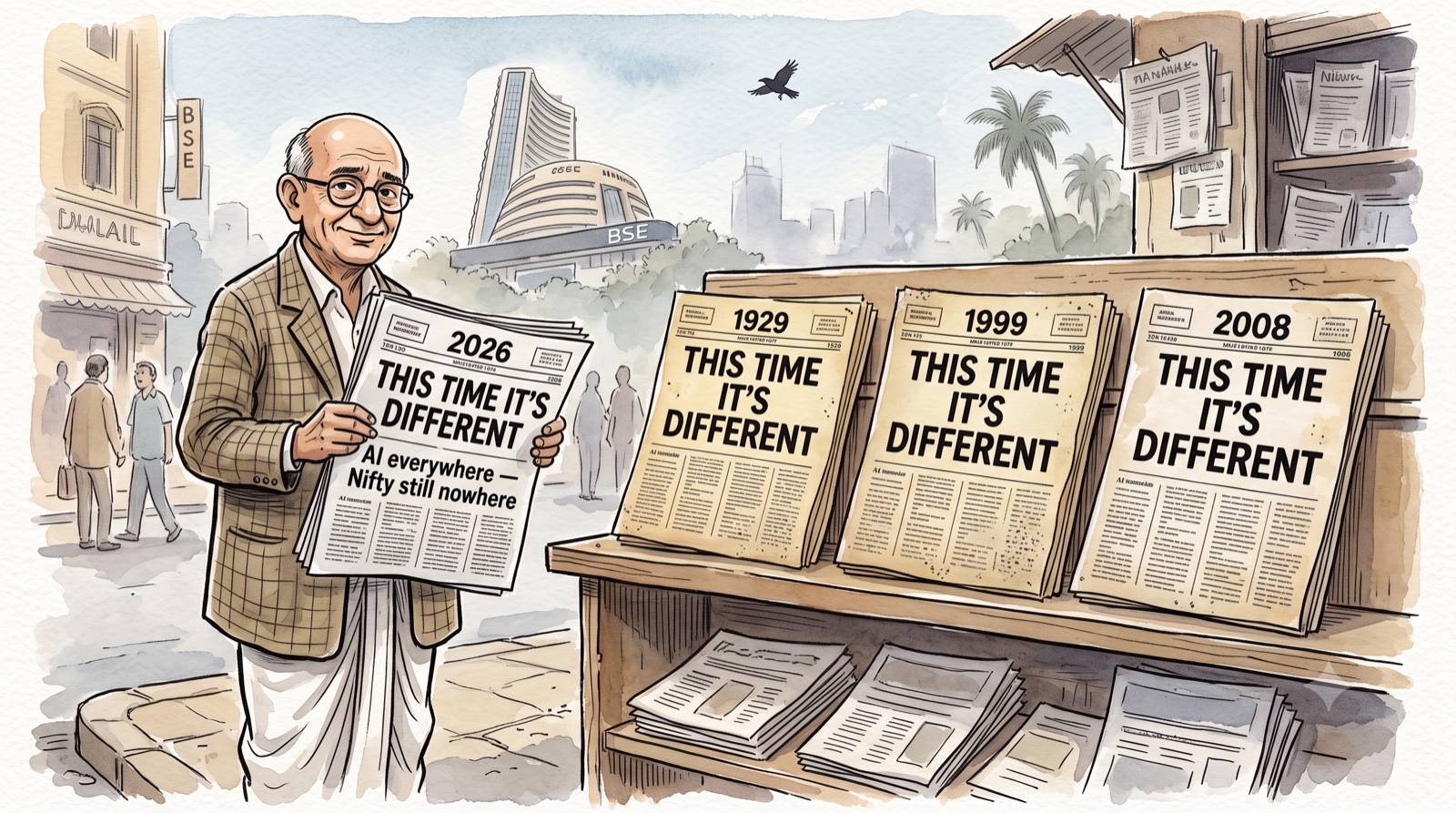
John Templeton’s framing of the four most dangerous words in the stock market has stood the test of time. The problem I have is that the nuance of what Sir John meant, and the intended meaning of the four words, isn’t understood by most investors. So, here goes.
If one were to look at the evolution of the stock market — the booms, the busts, and what caused each — it is easy to conclude that “it’s different every time.” The 1992 peak in the Indian stock market was caused by euphoria over the reforms agenda, the rapid depreciation of the INR, and a host of attendant factors. The 2000 peak was the dot-com bubble. In 2008 there was a financial crisis that was global — contagion from excesses in the US financial plumbing. The Covid upheaval registers as a blip; it was so short-lived that markets wisened up pretty fast. Call it the “wisdom of the crowds,” which is the polar opposite of the “madness of the crowds.”
The underlying meaning of Sir John’s words is being misconstrued. What he actually meant is that human behaviour remains the same, regardless. The mode changes; the mechanism doesn’t.
Templeton’s actual quote lives in a magazine essay titled 16 Rules For Investment Success, and it is worth reading in his own words:
“The only way to avoid mistakes is not to invest—which is the biggest mistake of all. So forgive yourself for your errors. Don’t become discouraged, and certainly don’t try to recoup your losses by taking bigger risks. Instead, turn each mistake into a learning experience. Determine exactly what went wrong and how you can avoid the same mistake in the future.
The investor who says, ‘This time is different,’ when in fact it’s virtually a repeat of an earlier situation, has uttered among the four most costly words in the annals of investing. The big difference between those who are successful and those who are not is that successful people learn from their mistakes and the mistakes of others.”
In 1990, John Kenneth Galbraith, the great economist, wrote in his book A Short History of Financial Euphoria:
“There can be few fields of human endeavor in which history counts for so little as in the world of finance. Past experience, to the extent that it is part of memory at all, is dismissed as the primitive refuge of those who do not have the insight to appreciate the incredible wonders of the present.”
But then he went on to say, in the same book:
“For practical purposes, the financial memory should be assumed to last, at a maximum, no more than 20 years. This is normally the time it takes for the recollection of one disaster to be erased and for some variant on previous dementia to come forward to capture the financial mind. It is also the time generally required for a new generation to enter the scene, impressed, as had been its predecessors, with its own innovative genius.”
That last insight is the one that is unique. What Galbraith pointed at was that the stock market attracts a new bunch of suckers every twenty years or so. Why is historical determinism so important in the Stock Market, and why do a new bunch of suckers always get ‘trapped’? Peter Bernstein has an answer, and it is a superb one — markets are shaped by what he called “memory banks.” Experience shapes memory; memory shapes our view of the future. The new ‘suckers’ don’t have that much of a ‘memory bank’. I should hasten to add, neither do the journalists and the rest of the self-anointed ‘Stock Market Gurus’.
The mode always changes. Now it’s day trading, options trading, mutual fund SIPs, a plethora of the same thing in a new avatar. The mode may have changed. Human behaviour is the same. And that isn’t surprising at all. Jesse Livermore said essentially the same thing a hundred years ago: “There is nothing new on Wall Street or in stock speculation. What has happened in the past will happen again, and again, and again. This is because human nature does not change, and it is human emotion, solidly built into human nature, that always gets in the way of human intelligence.” William Eckhardt, in Market Wizards, put it in his own vocabulary: “The markets may change, but people won’t.” Different centuries, different practitioners, same observation.
The ‘new bunch of suckers’, seem to be hiding in plain sight, I mean those aged from around 25 to 35 — new entrants to the workforce. They are hiding behind some investment vehicle or another — mostly Mutual Fund Schemes and SIP’s — ‘delusions of grandeur’? I mean Mutual Funds invest in the Stock Market — the same market. The other place where ‘they’ hide are online brokerages who peddle ‘Options Selling’ as a product. This cohort wants to make a quick buck — pretty normal. And there is a third type of sucker — those who make Templeton’s biggest mistake by not investing at all. I would consider this a change in mode, not a change in human behaviour.
#What is different this time
Why don’t we focus on what’s different this time? Each of these observations are independent — few of them flow from one to the other, since I am pointing at ‘behavioural changes’; it’s not one contiguous text and shouldn’t be read as such.
- The two chief protagonists of the whole AI revolution are Sam Altman and Dario Amodei, and then anybody else can chime in — and they do. Most of the fear-mongering has been done by these two gentlemen. That is different — very different. Two purveyors of a technological change that is seen as ‘transformational’ continue to keep broadcasting dystopian futures for mankind and humanity. We have seen plenty of technological change over the last two decades; never has it been the case that the persons who have brought about the change aren’t broadcasting how great it will be — they do the opposite. Yet, they continue to push forward at an almost startling pace.
- Markets trade alongside and react to all of the verbiage, that isn’t different at all. But, this time instead of mild opposition to all the verbiage, human beings aren’t too keen to embrace the change. To be sure, opposition to change is pretty normal human behaviour, regardless of age or gender. But this time the opposition is more unanimous, and also very loud. We have employees of Open AI and Anthropic who seem to want to protect humanity. The last time someone did this, I think it was ‘Edward Snowden’ — the most famous or infamous ‘whistleblower’. As on date, ‘whistleblowing’ is the behaviour du jour. I mean ‘ratting’ on your employer or behaving like a ‘snitch’ is now applauded. Many of these chaps are celebrities — ‘influencers’.
- For everyone be they Chinese or American, the AI revolution is being framed as a ‘race’. USA is racing with China, and then within the USA two companies are racing with each other. This has all the makings of a Winner’s Curse from a very early stage; mind you there is no ‘bidding war’ as such. The last time this happened was space exploration. At that time the USA and the USSR were ‘racing’. No one knows who won that race; looks like neither to me; I mean Elon Musk is the winner if there is one. Hindsight says that these races don’t end well. Will it be different this time?
- Government intervention normally happens when a business is very profitable; almost obscenely so. Governments want a cut after they belatedly realise that they are missing out on some easy revenue. In the current scenario — it’s the opposite. Since the whole AI debate is framed as ‘existential’, Governments (aka Politicians) are hyper active. And, my experience has been that government intervention kills businesses and also kills the business environment; there are no exceptions to this rule at all, so the change is probably the fact that Politicians are ‘early’ this time.
The rest of the stuff — noise levels in the media, bad capital allocation, extrapolation of dystopian futures — is all pretty normal. There is ONE BIG change that I have not listed above, and that is the fact that there is no ‘euphoria’ at all, quite the opposite, in fact.
#Neomania
- Nassim Nicholas Taleb is known for his articulation of the The Black Swan Theory. But, Taleb has written exhaustively on many other things as well. One of them is ‘Neo mania’. And, this time human beings aren’t behaving like they always do, that to me is very different.
- The word ‘Neomania’ is framed by Taleb in his book Antifragile: Things That Gain From Disorder. He defines it as: “the love of the modern for its own sake.” He calls it “a contemporary disease-linked to interventionism” and “incurable and untreatable” in those who have it worst. Today these folks are called ‘AI Pilled’.
- The mechanism is straightforward. When human beings are asked to imagine the future, they add to the present. They take today’s world as a baseline and stack new technologies, new products, new killer apps on top of it. Taleb’s line: “the prime error is as follows. When asked to imagine the future, we have the tendency to take the present as a baseline, then produce a speculative destiny by adding new technologies and products to it and what sort of makes sense, given an interpolation of past developments.”
- We over-technologize the future and under-weight the things that are still going to be around — the chair, the fork, the shoe, the fountain pen, the taverna. Taleb’s own dinner walk in the book reads like so: ‘sitting on a three-thousand-year-old device (a chair), eating with a Mesopotamian technology (a fork), drinking wine from a Phoenician technology (a glass), on a century-old technology (a cab), on paved streets that have been around since antiquity. Almost nothing at the dinner was less than a century old.’
- Neomania is the engine of technology bubbles. It is what makes markets keep bidding, keep extrapolating, keep believing that the newest thing will finally be the thing that replaces everything that came before it. And it is what always disappoints — because the actual future looks much closer to the actual present than any ‘Neomaniac’ ever forecasts.
- Taleb’s Lindy corollary: “For the perishable, every additional day in its life translates into a shorter additional life expectancy. For the nonperishable, every additional day may imply a longer life expectancy.” The old is durable precisely because it has survived. The new is fragile precisely because it hasn’t.
#Neomania — This Time It’s Different
Now — here is what is different about the AI moment, and it is genuinely different.
- Neomania is unusually muted this cycle. Not absent; but almost. There is no euphoria at all. The model labs are neomaniacal in their capital-expenditure programs, but that’s about it. The broader neomaniacal tone that historically accompanies a technological revolution — the confident cheerleading from the men in charge, the giddy consumer euphoria, the “the future is here and it is amazing” magazine cover — that tone is missing. The two chief protagonists, Altman and Amodei, are broadcasting dystopian futures. The framing is not a race to abundance; the framing is a race to catastrophe. That is not what neomania looks like.
- My sense tells me that since ‘imperfect understanding’ is the ‘human condition’, and extrapolating LLM technology as anthropomorphic is now par for the course, fear is the dominant emotion, not greed. So, Greed is the ‘human condition’ whenever we have neomania. This time the dominant emotion is ‘fear’, and that rhymes with ‘opportunity’ in the investing world.
- And the markets are ambivalent. Nifty is about 11% down YTD, and roughly 6% down over the trailing 12 months. The Nasdaq is up about 13% YTD and around 10% over the trailing 12 months — respectable, but a long way from the melt-up you’d expect from a genuine AI mania. Two of the biggest names in the Kospi index — the very South Korean semiconductor and memory companies that provide the “meat” for every unit of compute the hyper scalers are commissioning — are running buybacks when their stock prices are at all-time highs. The Neomania playbook would have them ploughing every rupee back into capacity for a demand curve they claim is bottomless. The signaling shows dissonance, prima facie not a sign of mania at all. Very strange to me.
- What happens when the Neomania and stock prices diverge like this is what practitioners call a sideways market. It is neither the euphoric melt-up of a classical bubble nor the panicked collapse of a bust. It is a confused market — and in Taleb’s frame a confused market is a fragile one, unusually vulnerable to a single piece of contrary evidence flipping the whole regime.
- So what is different this time is not that the technology is more transformative — every generation says that. What is different is that the technology is arriving without the neomania that usually funds its bubble. The people who normally sell you the future are selling you the dystopia instead. The markets that normally bid the new thing to the moon are trading sideways. The insiders who normally reinvest are buying back their stock.
- If you believe Taleb’s rule — what survives is what has been around — then a moment where neomania is unusually restrained is a moment where the Lindy-effect businesses are unusually under-priced. That is not the same argument as “AI is a bust.” It is the argument that the distribution of gains from this transition looks different from every prior one, and the difference cuts against the AI-native names and in favour of the physical, experiential, human-anchored ones. There is a name for this, and it is called Disintermediation. Once you strip out the neomania noise, the actual investment question in front of an Indian investor is dead simple: can AI insert itself between this business and its customer? If yes, the business is toast. If no, the business is what Taleb would call Antifragile.
#Conclusion
I picked up Hedgehogging by Barton Biggs recently, and while the book itself didn’t do much for me, I stumbled on a quote it carries from an older book — Ten Years of Wall Street by Barnie Winkelman. This one stayed with me, and it should stay with the AI-pilled crowd too.
“No discussion of the interrelation of stock prices and business conditions would be complete without emphasizing that in the clash of speculative forces on the exchange, the emotions play a part which is not paralleled in the normal processes of commerce and industry. The golden mean is non-existent in Wall Street, because the speculative mechanism does all things to excess; even the reactions from the heights of phantasy (sic) and from the depths of despair are accompanied by convulsions which are distinct from the calmer tenor of business. Those who seek to relate stock movements to the current statistics of business, or who ignore the strongly imaginative taint of stock operations, or who overlook the technical basis of advances and declines, must meet with disaster, because their judgment is based upon the humdrum dimensions of fact and figure in a game which is actually played in a third dimension of the emotions and a fourth dimension of dreams.”
Most investors do not appreciate the fact that the Stock Market game is played in the third and fourth dimension, and NOW is ALWAYS the hardest time to invest. I don’t think this will ever change, AI or otherwise, wanna bet?
