
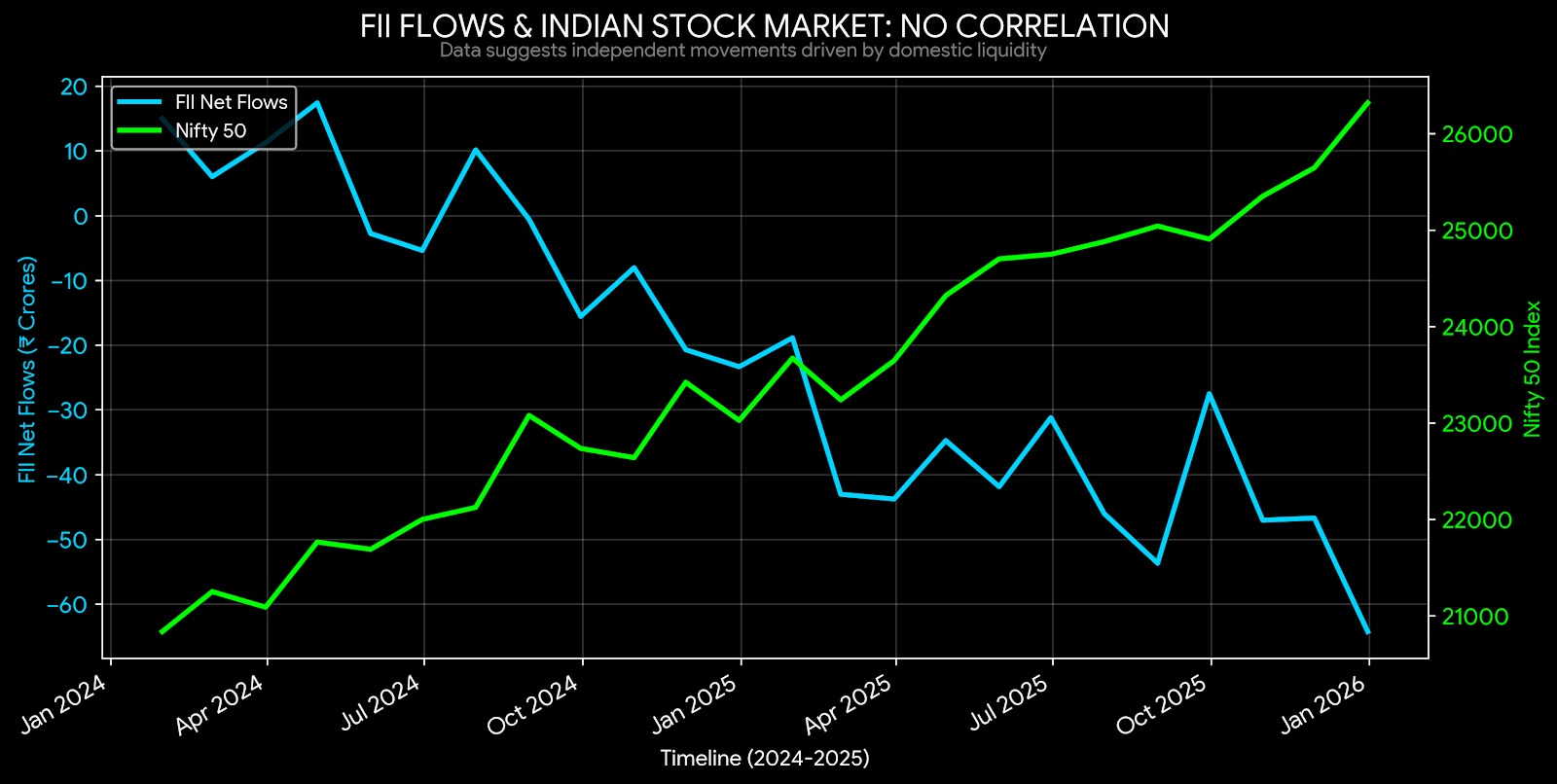
#The Fat Tony Lesson
In Nassim Taleb's book Antifragile, there's a character called Fat Tony — a street-smart trader who made $18 million during the Kuwait War while sophisticated analysts lost fortunes. Everyone expected war to raise oil prices. The "smart money" was long oil. But Tony bet against this consensus, reasoning: "if everyone expects it, it's already in the price." Oil collapsed from $39 to ~$20 when the war began.
Fat Tony's explanation? "Kuwait and oil are not the same ting."
Just because two things correlate (or seem like they should), drawing conclusions and placing bets on assumed correlations isn't prudent. As on date, even seasoned market participants seem to conflate the event, ergo persistent FII selling in Indian equities with falling stock prices of small and mid-cap stocks.
For Fat Tony, the distinction in life (and true for markets as well), isn't True or False, but sucker or non-sucker. A sucker focuses on being "right" in the abstract while ignoring practical consequences. A non-sucker focuses on exposure, payoffs, and what the data actually says.
#What Market Analysts See → What They Assume
- FII flows published daily → Must be important driver
- FIIs are buying → Market will go up
- FIIs are selling → Market will go down
- FII data is easy to track → Must explain market moves
But market participants seem to miss what the data shows — FII flows and Indian market movements are not the same 'ting'!
#The Conflation Error
The consensus assumption is that FII (Foreign Institutional Investor) flows drive Indian stock market movements. When FIIs buy, markets go up. When FIIs sell, markets go down. The data shows no such correlation. This is a textbook example of confusing correlation with causation — except the correlation itself doesn't exist.
#The Evidence
#Devina Mehra's Analysis (from her book, Money, Myths and Mantras)
1994–2003: The Definitive Test
"And 1994 to 2003 is the only nine-year period in Indian market history where the Sensex return was a net zero! This new slew of money came in and did absolutely nothing at all for the markets. Even on a month-to-month basis, there was no correlation between FII flows and stock market movements, as we used to track it closely during the nineties. Strangely enough, the very first month when the FII flows turned negative, meaning the FIIs were net sellers, the market was up. That was further proof to me that market movements could not be predicted by forecasting FII flows. It was an exercise in futility."
The Data:
- 1994–2003: Net FII inflows (started in earnest 1994) → Sensex return = Net zero → Correlation: None
- First month FIIs turned sellers: Net outflows → Market went up → Correlation: Inverse
- Month-to-month basis: Tracked closely → No pattern → Correlation: None
Her key quote: "It has always amazed me that no one wants to look at the data to see whether there is a correlation at all between FII flows and Indian market movements!"
#Why the Myth Persists
#Affirming the Consequent (The Media Logic Trap)
The media creates this narrative through a formal logical fallacy (syllogism):
- Premise 1: If FII sells (P), then market goes down (Q)
- Premise 2: Market went down today (Q)
- Conclusion: Therefore, FII must have sold (P)
After a market move, the media needs to find reasons — as long they are plausible and the retrospective pattern matches, we are stuck with this narrative.
#Reality Beats Perceptions
ALL market movements all over the world are just due to the most simple dynamic — more buyers than sellers or vice-versa. Which is another way of saying that any imbalance between the equation will cause a shift.
#The Math That Breaks the Narrative
Total Market Participants:
- Retail investors (buying/selling)
- Domestic Institutional Investors / DIIs (buying/selling)
- Foreign Institutional Investors / FIIs (buying/selling)
- Proprietary traders (buying/selling)
- High-frequency traders (buying/selling)
Market movement depends on NET IMBALANCE across ALL participants. FII flows are just one component of total buying/selling.
#The Fundamental Mechanism (William Bernstein)
"Anyone uttering such nonsense should be pulled over by the finance police and forced to wear a bright red sign around their neck labeled 'Rube.' To reiterate, for every seller there is a buyer, and vice versa. All that changes is the price at which market transactions occur." — William J. Bernstein, The Investor's Manifesto
#The Error in "More Buyers Than Sellers"
If the media were to ever say: "Markets went up because there were more buyers than sellers today," strictly speaking that wouldn't be correct. What actually happens:
- When buying pressure increases, the price must RISE to the point where it induces holders to sell
- When selling pressure increases, the price must FALL to the point where it induces buyers to step in
Key Points:
- It's not about NUMBER of buyers vs. sellers
- It's about the INTENSITY of their desire to transact
- Price adjusts until equilibrium is reached
#Applying This to FII Flows
The FII narrative assumes: "FII selling → More sellers than buyers → Market falls"
But Bernstein's mechanism shows: For every rupee FII sells, someone BUYS that rupee. Total sellers = Total buyers (always).
The question is: At what PRICE does equilibrium happen?
In markets, price is set by the most panicked seller (buyer) at the end of a trading day. Size of flow matters LESS than the INTENSITY (urgency) of the desire to transact.
#Conclusion
Correct mental model (Bernstein): FII flows are like an auction. When FII wants to sell, price adjusts until someone is willing to buy. When FII wants to buy, price adjusts until someone is willing to sell.
The media in particular, and market participants seem to be asking the wrong question. Instead, ask:
- Are stocks gapping up on volume? (Buyers desperate)
- Are stocks breaking support on low volume? (Sellers give up, buyers patient)
- Is the market absorbing selling easily? (Strong hands buying)
- Is the market rejecting rallies? (Weak hands selling)
