
#A Brief History of Regulatory Whiplash
When Buffett talks about buybacks, he talks about price discipline, opportunity cost, and per-share intrinsic value. When Thorndike studies the outsider CEOs, the regulatory environment is background noise — it exists, but it doesn't fundamentally alter the capital allocation equation. In India, the regulatory environment is the capital allocation equation.
Here's what SEBI and the Finance Ministry did to buybacks in India over a span of less than three years. The regime, year by year:
| Period | Buyback Tax | Who Pays | Open Market Route | Tender Offer Route |
|---|---|---|---|---|
| 2013 | 115QA introduced (unlisted only) | Company | Available | Available |
| Jul 2019 | 115QA extended to listed; ~23.3% on distributed income | Company | Available | Available |
| 2023 onwards | Company tax continues | Company | Phase-out begins: 15% → 10% → 5% caps | Available |
| Oct 2024 | 115QA repealed; deemed dividend at slab rates | Shareholder (up to 35.88%) | Cap continues | Available |
| Apr 2025 | Slab-rate deemed dividend | Shareholder | Banned | Only route left |
| Feb 2026 (Budget) | Reverts to capital gains (LTCG 12.5% / STCG listed 20%) effective 1 Apr 2026 | Shareholder | Banned | Only route |
| Apr 2026 | Capital gains regime live | Shareholder | SEBI consultation paper to reintroduce | Available |
- The 2019 extension to listed companies created its own asymmetry: participating shareholders got a tax-free exit, non-participating shareholders got nothing.
- Read that sequence again. In the space of three years, the Indian regulator banned open market buybacks, made the remaining route (tender offers) punitively expensive for shareholders, watched buyback activity collapse by 71% — from 48 issuances in 2023-24 to just 14 in 2025, with companies shifting to dividends instead — and is now proposing to undo both decisions.
#The Stated Rationale
SEBI's case for the 2023 phase-out (row 3 of the table above) rests on one phrase: "equitable treatment of shareholders." The concern was that in an open market buyback, one shareholder's sell order could be matched entirely with the company's purchase order, giving that shareholder a disproportionate benefit while others couldn't participate. To me this sounds stupid — plain and simple.
Every time anyone sells a stock on an exchange, the trade is matched with a buyer. That's what an exchange does. The fact that the buyer happens to be the company itself doesn't change the mechanics. Every shareholder had the same opportunity to sell into the buyback. The ones who chose not to sell benefited from the reduced share count — their proportional ownership increased. That's not inequity. That's how buybacks work.
As Buffett explained at the 2012 Berkshire meeting: "The value per share goes up when we buy at 110% of book, and it's so obvious to us, that we would do it on a big scale if given the chance." The non-participating shareholders benefit automatically because the pie is now split among fewer slices.
The per share value climbs, since the denominator — the free float of shares available — shrinks. Isn't that common sense?
#The Tax Disaster
But the regulatory route was only half the damage. The real devastation came from the Finance Ministry.
When buyback proceeds were reclassified as "deemed dividends" in October 2024, the tax treatment became absurd. Consider a shareholder who bought a stock at ₹500 and participated in a buyback at ₹600. Under rational tax treatment, the capital gain is ₹100, taxed accordingly. Under the deemed dividend treatment, the entire ₹600 was taxable as income at slab rates — with no deduction for the cost of acquisition. This is a fundamental error. Return OF money is return of capital — in principle, return of capital cannot be taxed. What is taxable is Return ON money, not Return OF money. Period.
Yes, you could claim a capital loss on the bought-back shares — but that loss could only be offset against future capital gains, creating a timing mismatch that disadvantaged every participating shareholder. The practical effect was to make buybacks irrational for any shareholder in a high tax bracket. The market responded predictably. Companies stopped doing buybacks. Activity collapsed. And the capital that would have been returned to shareholders through repurchases went where? Into dividends — which, ironically, are also taxed at slab rates but don't offer the per-share value enhancement that buybacks do.
#The Indian Jugaad: Tender Offer Buybacks
Now let's talk about the one route SEBI didn't ban — the tender offer.
Globally, a buyback is simple. The company buys shares in the open market. The shares are extinguished. The remaining shareholders own a larger slice of the same pie. Everyone's per-share value goes up. In India, SEBI mandated the tender offer as the only buyback route. And in a tender offer, the promoter is allowed to participate. Read that again. The promoter — the controlling shareholder — can tender their shares to the company.
Now think about what this actually means. The company uses its cash (which belongs to all shareholders proportionally) to buy back shares from... the promoter. The promoter gets cash. The company's treasury gets depleted. The share count may not move much — but the promoter's percentage holding goes up regardless. If the promoter tenders, they reduce their absolute shareholding but the remaining public float shrinks even faster. If the promoter doesn't tender, their percentage automatically increases as public shares are cancelled. Either way, the promoter wins. The mechanism was designed this way. But wait, it gets worse.
The tender offer buyback in India wasn't invented as a capital allocation tool. It was invented as a disinvestment tool. The government — as the promoter of PSUs — needed a way to reduce its stake in public sector companies and collect cash for the fiscal deficit, without the political optics of a traditional stake sale. A buyback achieves this beautifully: the PSU uses its own cash to buy back the government's shares. The government gets the money. The PSU's balance sheet shrinks. And the headline reads "buyback" instead of "disinvestment" — much cleaner politically.
PSUs falling under the DIPAM threshold — Coal India, NTPC, ONGC, NMDC, BHEL, HAL — were directed via the guideline to conduct buybacks. Not because these companies had determined that their stock was trading below intrinsic value. Not because the boards had evaluated opportunity costs and concluded that repurchases were the best use of capital. But because the government needed the cash to meet its deficit target.
The May 2016 DIPAM guidelines mandated that all CPSEs with net worth above ₹2,000 crore and cash/bank balance above ₹1,000 crore shall exercise buyback options. "Shall." Not "may consider." Shall. The 18 November 2024 revision raised the thresholds to ₹3,000 crore net worth and ₹1,500 crore cash, softened the language from shall exercise to may consider, and added a precondition that the market price must have been below book value for the prior six months — but the structure that produced a decade of PSU-buyback-as-disinvestment was already baked in.
This is the opposite of capital allocation. This is cash extraction dressed up as shareholder value. The company's cash — accumulated over years of operations, belonging to all shareholders — is routed to the government via a mechanism designed to look like a buyback but function like a dividend specifically to the promoter.
And SEBI, the market regulator whose stated purpose is investor protection, allowed this to become the standard mechanism. Then they banned the open market route — the one route where promoters couldn't participate — citing "equitable treatment of shareholders."
Filter the SEBI actions above through capital allocation and shareholder value, and you arrive where I left off in my prior post — Buffett's One Test for Management. Most CEOs Fail It.: the whole process stinks to high heaven.
#The Indian Capital Allocation Problem
This is where the Indian version of Buybacks diverges from global context completely. Globally, capital allocation is primarily a management problem. The regulatory framework is stable, the tax treatment is understood, and the toolkit is available. A CEO's ability to allocate capital well is constrained mainly by their own judgment.
Thanks to SEBI and the Indian Finance Ministry, Corporate India's capital allocation toolkit is volatile, and so is the attendant tax regime. A CEO who designs a capital return strategy today may find that strategy legislated out of existence tomorrow. This creates an additional layer to the management quality assessment for Indian investors. It's not enough to ask: does this management team understand capital allocation? You also need to ask: can this management team navigate a capital allocation framework that shifts every 18 months? The outsider CEOs that Thorndike profiles were foxes as defined by Isaiah Berlin — they made connections across fields and adapted to changing conditions. In India, being a fox isn't optional. It's survival.
In India, capital allocation is a regulatory problem first and a management problem second. SEBI is interfering in capital allocation of Corporate India without having any stake in the same. SEBI isn't a shareholder, yet it wants a say in how the free cash flow of the business is allocated. This is absurd. Capital allocation of a business in which SEBI has 'no skin in the game' is none of their business — they should stay out of the whole thing. PSU stocks may need a special regime — ideally even that isn't correct — but why the rest of Corporate India?
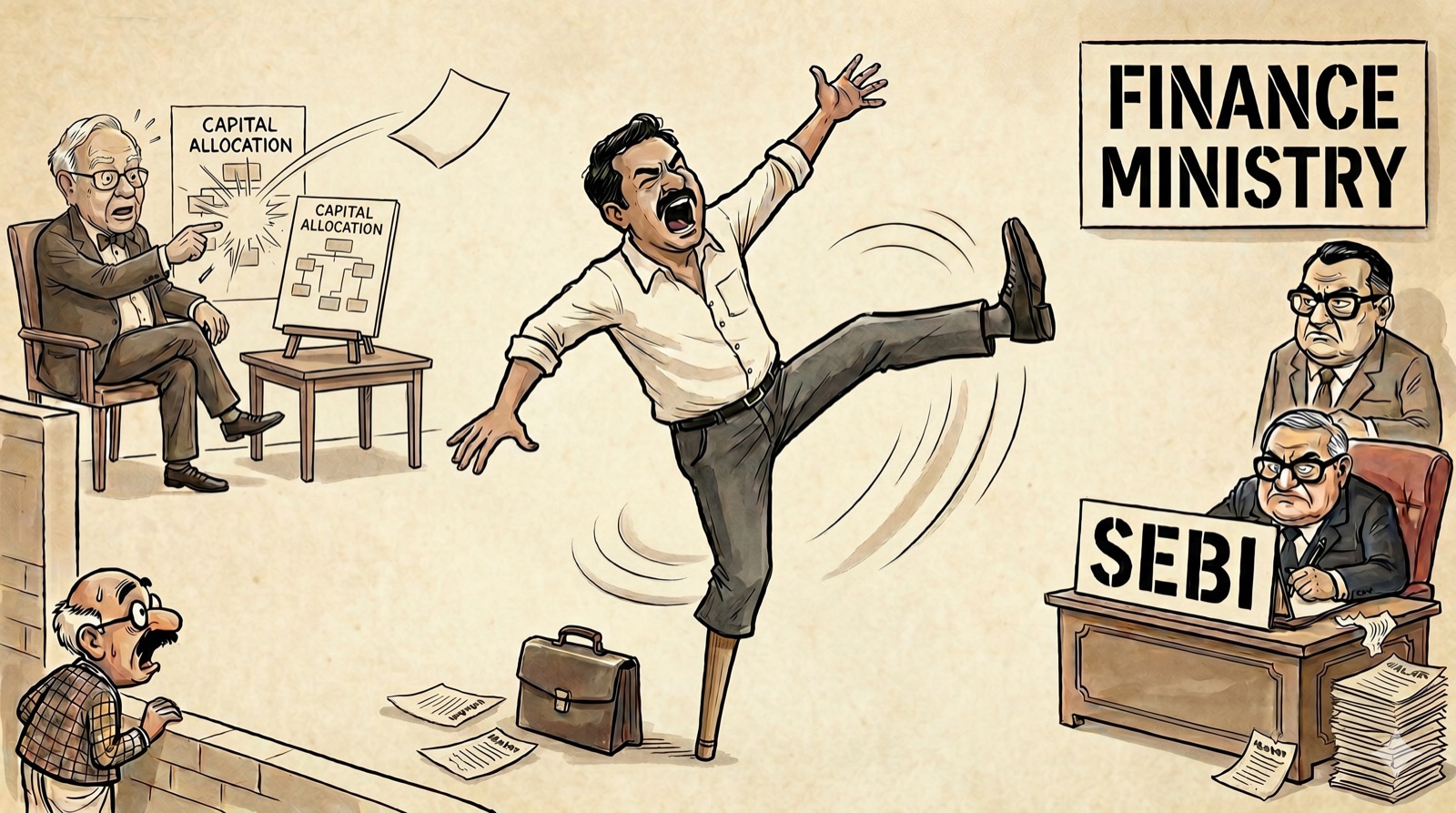
Buybacks are the most potent tool in the Capital Allocation tool kit, and SEBI just barged in and rammed it out of existence. What is even more shocking to me is that no one seems to mind! To use a Mungerism — Corporate India is like the 'one legged man in an ass kicking competition'.
Postscript: As of April 1, 2026, the regime has reverted to the capital gains model. In the ₹500 → ₹600 example above, you're once again taxed only on the ₹100 gain; your ₹500 principal is protected from the taxman. For now.
